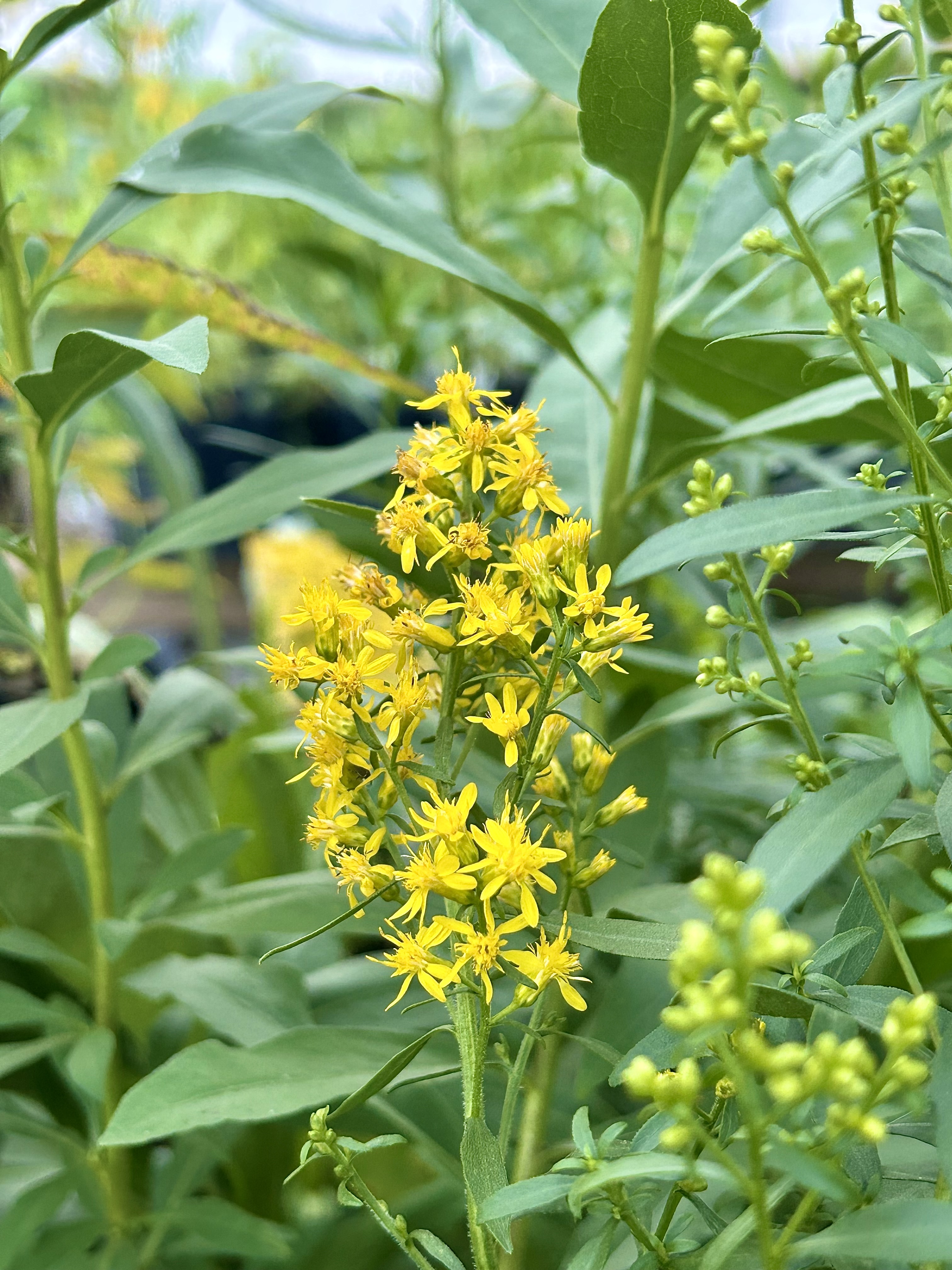
Solidago juncea (Early Goldenrod)
$8.00
Out of stock
Size: 2-4’ tall / 2-3’ wide
Sun: Full Sun - Part Sun
Soil: Dry-Medium, Well-Drained
Bloom Time: Late Summer
Deer Resistance: 3.5/5
Ecotype: Unknown
Solidago is a large, often misunderstood genus consisting of more than 100 species that are native to North America. With so many individual species, it should be clear that not all goldenrods are the same! Some are aggressive spreaders that colonize by sending out thick rhizomes in every direction, perfect for stabilizing large, recently-disturbed areas; others are more clump-forming, well-behaved, and play nicely with other perennials in a garden setting. Regardless of the species, two things are true:
They do not cause allergies. The flowers are insect-pollinated, whereas the pollen that causes allergies originates from plants that are wind-pollinated, like Ragweeds (Ambrosia spp.).
They are a keystone species. They serve as a larval host plant for more than 125 butterfly and moth species, and the flowers are a crucial late-season food source for all pollinators. No pollinator garden is truly complete without at least one species of goldenrod.
You can probably guess why this species is called "Early Goldenrod." While other species of goldenrod begin their displays in the fall, Early Goldenrod is unique in that it blooms in late summer-- as early as July. This species spreads via rhizomes and may be too aggressive for tidier garden beds. I recommend planting it in larger spaces where it can sprawl, or take advantage of its spreading nature to help cover a recently disturbed area. If divided and thinned every couple of years, this plant could still be used in a garden setting.
